About the dharamshala
A place of rest for pilgrims and devotees visiting Nathdwara for the darshan of Lord Shrinathji.
Our story
Jai Shri Krishna
- Samvat 1944
- Tilkayat Maharaj Goswami Govardhanlalji allots land beside Lal Bazar to Seth Jamnadas Lallubhai, for a dharamshala for pilgrims.
- Samvat 1981
- Seth Jamnadas Lallubhai builds the dharamshala, which comes to be known as Bombaywala Dharamshala, or Badi Dharamshala.
- 1994
- The building is reconstructed, with shops on the ground floor and rooms for yatris on the first and second floors.
The trust
The dharamshala is managed and administered by Seth Jamnadas Lallubhai Charitable Trust, Mumbai, founded by the heirs of Seth Jamnadas Lallubhai as per his wish. Rooms of several categories can be booked at affordable rates by devotees and pilgrims.
The Shrinathji temple
The Shrinathji temple in Nathdwara, whose name means "Gateway to the Lord", is one of the most important pilgrimage sites for followers of the Pushtimarg tradition of Vaishnavism, founded by Vallabhacharya in the 16th century. At its heart is Shrinathji, the seven-year-old child form of Lord Krishna, lifting Govardhan Hill with one arm to protect the villagers of Vrindavan from the rains sent by Indra.
Origin of the deity
The deity of Shrinathji is believed to have emerged from Govardhan Hill near Mathura, where Vallabhacharya and his followers first worshipped it.
Coming to Nathdwara, 1672
The deity was moved from Mathura for its protection. On the way to Mewar, the chariot carrying it stuck in the mud near present-day Nathdwara. The priests took this as a divine sign, and the deity was installed there.
The temple
Rana Raj Singh of Mewar gave his patronage to the temple. Over time, Nathdwara became a major centre of Krishna devotion and art.
Pichwai painting
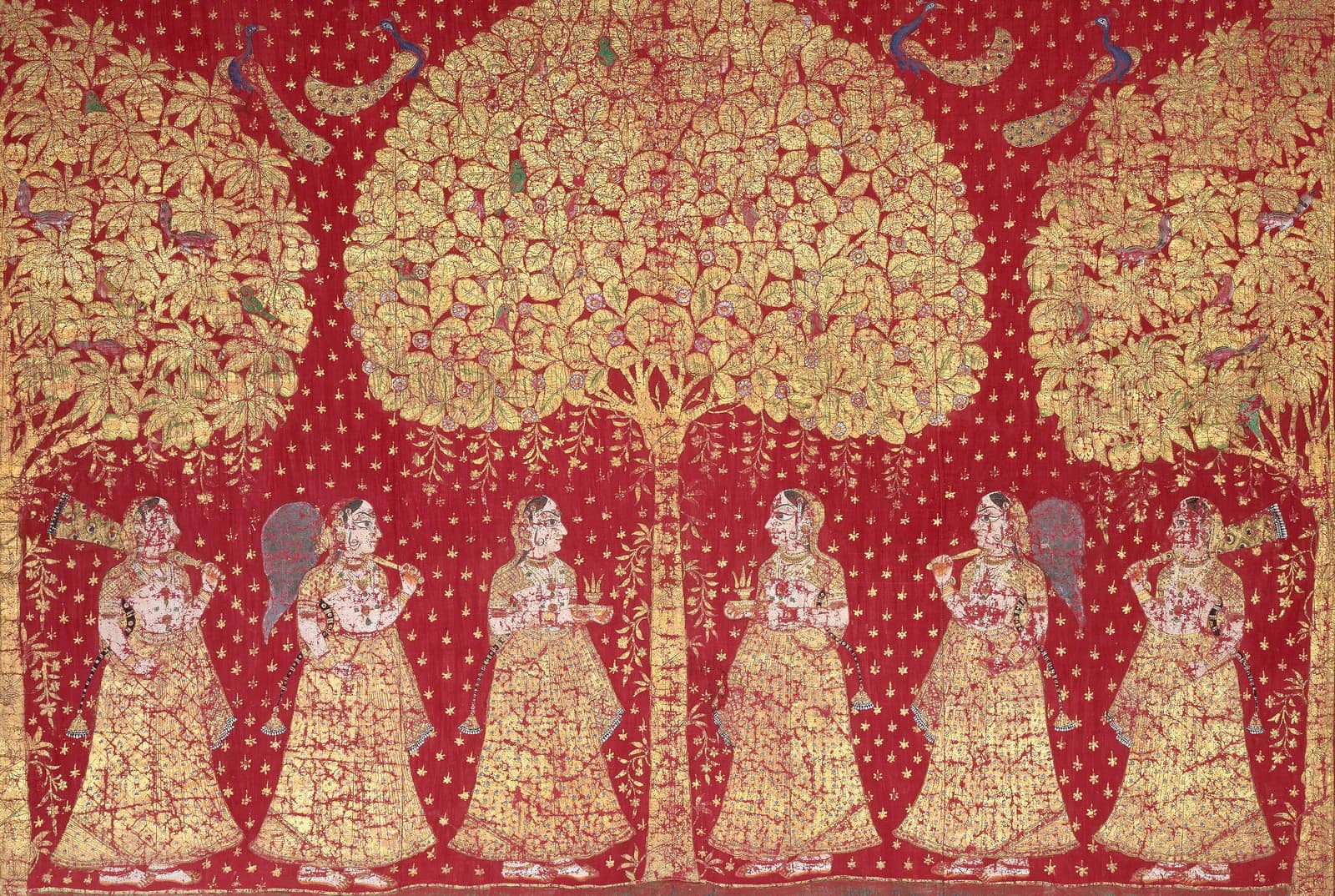
The temple inspired the school of art known as Pichwai painting, which tells the stories of Shrinathji. The paintings on this website are old temple hangings of this kind.